

Roger Hargreaves was the British author and illustrator who created the Mr. Men and Little Miss books, starting with Mr. Tickle in 1971. He wrote and drew the characters until his death in 1988, and his son Adam has continued the series ever since.
Quick Facts
| Detail | Information |
|---|---|
| Full name | Charles Roger Hargreaves |
| Born | 9 May 1935, Cleckheaton, West Yorkshire, England |
| Died | 11 September 1988 (age 53), Tunbridge Wells, Kent, England |
| Occupation | Author and illustrator |
| Known for | Mr. Men and Little Miss book series |
| Active years | 1971 to 1988 |
| Debut book | Mr. Tickle (1971) |
| Family | Married, four children, including Adam Hargreaves |
Who Was Roger Hargreaves
Charles Roger Hargreaves was born on 9 May 1935 in Cleckheaton, a small town in West Yorkshire, England. He spent his career turning simple, round doodles into some of the best-selling children’s characters in publishing history. By the time he died in 1988, his Mr. Men and Little Miss books had sold well over a hundred million copies and made him one of Britain’s most read authors.
His work is easy to describe but hard to copy. Each character is built around a single trait, drawn in a shape a child can recreate with a crayon, and wrapped in a story short enough to read before bedtime. That formula turned a one-off idea into a series that has outlasted its creator by decades.
Early Life in Cleckheaton
Hargreaves was born at a private hospital on Bath Road in Cleckheaton to Alfred Reginald and Ethel Mary Hargreaves. He grew up nearby on Halifax Road, in an ordinary Yorkshire household where his father ran a laundry and dry-cleaning business.
He worked in that business for about a year after leaving school, and there was nothing in his early jobs that pointed toward children’s publishing. Cleckheaton in the 1940s and 1950s was a mill town, not a place with an obvious path into books or illustration.
What he wanted, from a young age, was to draw. Cartooning was his actual ambition, but paying work in that field was hard to find in postwar Yorkshire, so he moved into advertising instead. That detour turned out to matter more than he could have known at the time, since it put him in daily contact with the exact skill his later books needed: saying something in as few lines as possible.
A Career in Advertising Before Mr. Men
Before he ever drew Mr. Tickle, Hargreaves worked in London advertising, eventually rising to creative director at an agency. The job used the same instincts that later made his children’s books work: a clear idea, a simple image, and no wasted words.
He wrote and illustrated on the side for years without any children’s book to his name. Colleagues from that period remembered him sketching constantly, filling notebooks with rough figures long before any of them had names or stories attached.
The Mr. Men series did not come from a five-year plan or a publishing pitch. It came from one ordinary question asked at home, on an evening like any other, from a son who wanted a straight answer.
How Mr. Tickle Started It All
The story behind Mr. Tickle is one Hargreaves told often. His young son asked him what a tickle actually looked like, and rather than answer in words, Hargreaves picked up a pen. He drew a round orange figure with arms long enough to reach around a house, and Mr. Tickle was born.
Turning that sketch into a published book took effort. Hargreaves struggled to find a publisher willing to take a chance on such a plain, small format, and several turned him down before one said yes. The format itself was part of the risk: a square-ish little book, one character, one idea, and almost no text on each page, which was not how children’s publishing usually worked at the time.
Mr. Tickle finally reached shelves in August 1971, and it sold more than a million copies within three years, a pace that surprised even his publisher. Readers who had grown up on longer, wordier picture books responded to something they could read in under two minutes and still remember the next day.
The Mr. Men Series Takes Off
Once Mr. Tickle found readers, Hargreaves kept the characters coming. Mr. Happy, Mr. Bump, Mr. Nosey, Mr. Greedy, Mr. Sneeze, and Mr. Snow all appeared in that first wave, each one built around a single word a child already understood.
The books also moved beyond print quickly. In 1974, the BBC turned the series into an animated show narrated by Arthur Lowe, with a second run following the next year. A Mr. Men comic strip ran in the Daily Mirror as well, putting the characters in front of readers who never picked up the books directly.
By 1976, sales had grown enough that Hargreaves left his advertising job for good and wrote full time from home. He kept the working method he had already settled on: a name, a single trait, a rough sketch, and a short story built around a situation any child would recognize, like being too messy, too fussy, or too slow to keep up.
How Roger Hargreaves Made a Character Work
What set Hargreaves apart from other children’s authors of his era was not the drawing style, which he kept deliberately basic, but the discipline behind it. Every Mr. Men or Little Miss character starts from one trait and one trait only. There is no Mr. Happy-but-also-a-bit-anxious, and there is no Little Miss Bossy who softens halfway through her own book.

That single-trait rule made the books easy for very young readers to follow and easy for parents to read aloud without losing anyone’s attention. It also made the characters simple enough for a child to draw themselves, which turned reading into an activity kids could copy rather than only watch. Hargreaves rarely explained this approach in interviews, but the books themselves show a writer who understood exactly how much a four-year-old could hold in their head at once, and refused to add anything past that limit.
The Little Miss Series
Ten years after Mr. Tickle, Hargreaves introduced the Little Miss line in 1981, giving the format a female-led counterpart. Little Miss Bossy, Little Miss Helpful, and later Little Miss Twins, written for his own twin daughters, joined the shelf alongside the original Mr. Men characters.
The series became a television show of its own in 1983, narrated by the real-life married couple Pauline Collins and John Alderton. Between the two series, Hargreaves had built a matched pair of properties that publishers still lean on today for new spin-offs, clothing lines, and character collaborations.
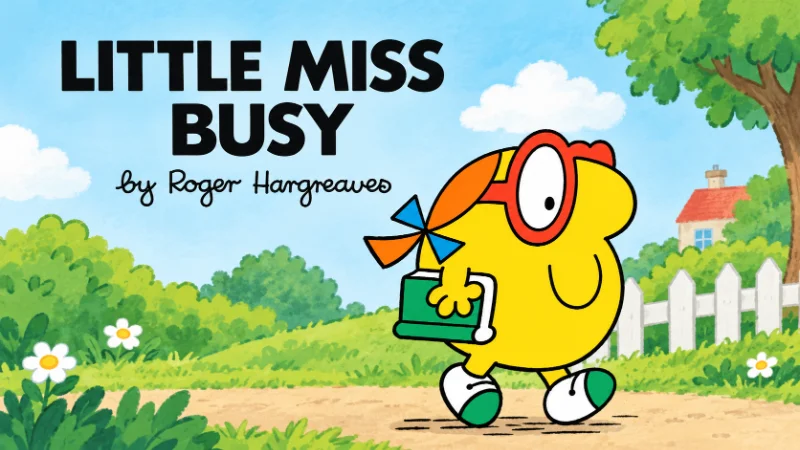
Little Miss also gave Hargreaves room to try traits the Mr. Men line had not covered as directly, including bossiness, shyness, and stubbornness, each handled with the same light touch. None of the books moralize outright. The character usually just runs into the natural result of their own trait, learns something small, and the story ends.
Beyond Mr. Men: Timbuctoo and Other Stories
Mr. Men and Little Miss made Hargreaves famous, but they were not the only stories he wrote. He created a 25-book series called Timbuctoo, along with other titles including John Mouse and the Roundy and Squarey books, aimed at slightly different age groups and formats.
None of these matched the reach of his two main series, and most readers today have never heard of them. They do show that Hargreaves kept experimenting throughout his career instead of repeating one successful formula for two decades straight.
Family Life
Hargreaves married and had four children, including his son Adam, whose question about tickling led directly to Mr. Tickle. Working from home as a full-time writer and illustrator after 1976 meant he was around for his children in a way his earlier advertising job had not allowed.
That closeness shows up in the books themselves. Little Miss Twins was written specifically for his twin daughters, and several other stories drew on small, ordinary moments from raising four kids rather than on any outside research. Adam later described his father as someone who worked at a normal desk in a normal room, not a separate studio set apart from the rest of family life, which meant the children were often nearby while new characters were taking shape.
That everyday setting matters for understanding where the books came from. Hargreaves was not observing children from a distance to gather material. He was drawing what was already happening a few feet away from him on an ordinary afternoon.
Death and Legacy
Roger Hargreaves died on 11 September 1988 at the age of 53, following a stroke, at a hospital in Royal Tunbridge Wells, Kent. He was buried at Cowden Church in East Sussex, on land next to the graveyard that he had bought himself in advance.
His son Adam took over writing and illustrating both series after his father’s death, signing new books with his father’s original signature rather than his own. Readers picking up a Mr. Men book today are, in a technical sense, buying a book Adam wrote, credited under a name that is not his.

The family held the publishing and merchandising rights until 2004, when Hargreaves’s widow sold them to the entertainment group Chorion for 28 million pounds. Chorion later sold the brand to the Japanese company Sanrio in 2011, and it remains under that ownership today, with Adam still involved as a creative consultant on new characters and designs.
The scale of what Hargreaves built is still visible decades later. Mr. Men and Little Miss have appeared in more than 90 books, been translated into over a dozen languages, and generated hundreds of licensed products, from clothing to homeware. In 2021, the 50th anniversary of Mr. Tickle brought a Royal Mint coin collection featuring characters redesigned by Adam Hargreaves, along with hometown events in Cleckheaton marking the milestone. For a man who started with a single question about what a tickle looks like, that is a fairly large answer.