
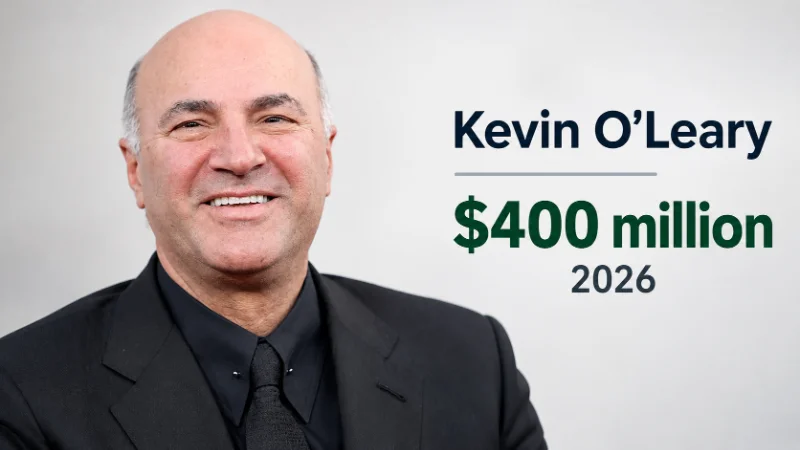
Kevin O’Leary’s net worth is usually put at about $400 million, but Celebrity Net Worth currently lists $150 million, and that $250 million gap shows how little of his wealth is publicly documented. O’Leary, 72, is the Canadian investor known as Mr. Wonderful on Shark Tank. The best-documented piece of his fortune is a single software sale in 1999, followed by decades of fund management, television work, and business stakes.
Much of his money sits in private companies with no public price tag. This article lays out the competing estimates, explains why they split, and separates what is documented from what is guesswork.
How Much Is Kevin O’Leary Worth in 2026?
No audited figure exists, so every number is an estimate. Fortune cited an estimated net worth of about $400 million in a March 2026 article. Celebrity Net Worth, on a page updated May 12, 2026, lists $150 million.
| Source | Estimate | Date |
| Fortune | About $400 million | March 2026 |
| Celebrity Net Worth | $150 million | Updated May 12, 2026 |
Smaller sites repeat $400 million or $450 million, and some attribute the number to Forbes without showing a Forbes page. Since none of them show how they got there, this article treats $400 million as the most commonly repeated figure, not a verified one.
Why the Estimates Differ by $250 Million
Net worth estimates start from documented events such as company sales, disclosed stakes, and reported income. For O’Leary, the biggest event is the 1999 sale of The Learning Company to Mattel, and the sources disagree on what he took home.
Wikipedia says the sale netted him around $6 million. Celebrity Net Worth estimates $35 million to $40 million for his 1.2% stake, plus a $5 million severance after Mattel fired him about six months later. The two also differ on deal size, with Wikipedia and Fortune citing $4.2 billion and Celebrity Net Worth citing roughly $3.9 billion.
That means the $4.2 billion in many headlines is not his payday. It is what Mattel paid for the whole company, and by Celebrity Net Worth’s count his share was 1.2%.
The second source of the gap is private holdings. Fortune reports that he holds investments in more than 30 private-venture companies, and private stakes have no market price. Every estimator has to guess at their value, which is how two outlets end up $250 million apart. Celebrity Net Worth itself says its figures come from public sources and are only estimates.
From a Toronto Basement to a $4.2 Billion Sale
O’Leary was born in Montreal on July 9, 1954. His father, a salesman, died when he was seven, and his stepfather’s work with the International Labour Organization moved the family through places such as Cambodia, Ethiopia, Tunisia, and Cyprus. He earned an MBA in entrepreneurship from the Ivey Business School in 1980 and worked at Nabisco, first as an intern and then as an assistant brand manager, a job he later credited for his marketing skills.
His first company was a television producer, Special Event Television, which made hockey programming and had limited success. A partner eventually bought his share for $25,000.

He put that money, plus a $10,000 loan from his mother, into SoftKey, which he started in a Toronto basement in 1986 with partners John Freeman and Gary Babcock. The company sold CD-based software for Windows and Macintosh computers. O’Leary persuaded printer makers to bundle its programs with their hardware, which gave SoftKey distribution before it had a brand.
From there the company grew by buying rivals. It took over WordStar and Spinnaker Software by 1993, bought The Learning Company for $606 million in 1995 and adopted its name, then bought Broderbund for $416 million in 1998. The combined business owned well-known educational titles including Reader Rabbit, The Oregon Trail, and Where in the World Is Carmen Sandiego, according to Celebrity Net Worth. Fortune reports that it reached more than $800 million in annual sales, with 2,000 employees and subsidiaries in 15 countries.
Mattel bought the company in 1999 for $4.2 billion, and the deal went badly. Wikipedia reports that The Learning Company had lost $105 million in 1998 and that O’Leary was fired after the sale. Shareholders sued, and Mattel paid $122 million to settle in 2003, while O’Leary and the other defendants disputed the charges and blamed a technology downturn and a clash between the two companies’ cultures.
Rebuilding With Storage, Funds, and ETFs
His next documented win was small by comparison. In 2003 he became a co-investor and director at StorageNow Holdings, a Canadian developer of climate-controlled storage. His stake started at about $500,000, and after Storage REIT bought the company for $110 million in 2007, Wikipedia reports a profit above $4.5 million.
In 2008 he co-founded O’Leary Funds, a mutual fund firm focused on income. Its assets grew from $400 million in 2011 to $1.2 billion in 2012, according to Wikipedia. Results drew less praise: Celebrity Net Worth says the funds faced scrutiny for trailing the broader market, and in 2014 the firm agreed to pay penalties to Quebec’s securities regulator. He sold the fund business to Canoe Financial in October 2015.
Fortune now lists him as chairman of O’Shares ETF Investments and of the robo-advisor Beanstox, and he also owns O’Leary Ventures and O’Leary Fine Wines. No source reviewed gives a valuation of his stake in any of them.
What Shark Tank Adds to the Picture
O’Leary joined the CBC show Dragons’ Den in 2006 and moved to its sister show Shark Tank in 2009, when producer Mark Burnett invited him and fellow Dragon Robert Herjavec. Shark Tank averaged 9 million viewers an episode at its peak in the 2014 to 2015 season, according to Wikipedia.
On Dragons’ Den his blunt style was encouraged by the show’s executive producer, Stuart Coxe, who sometimes asked him to be meaner during the first two seasons. The persona carried over to Shark Tank, where he became known for deals structured as loans repaid from a share of future revenue instead of equity. Those investments are held in a holding company called Something Wonderful. Two exits are documented: Talbott Teas, later bought by Jamba Juice, and GrooveBook, which he backed alongside Mark Cuban and Shutterfly later bought.
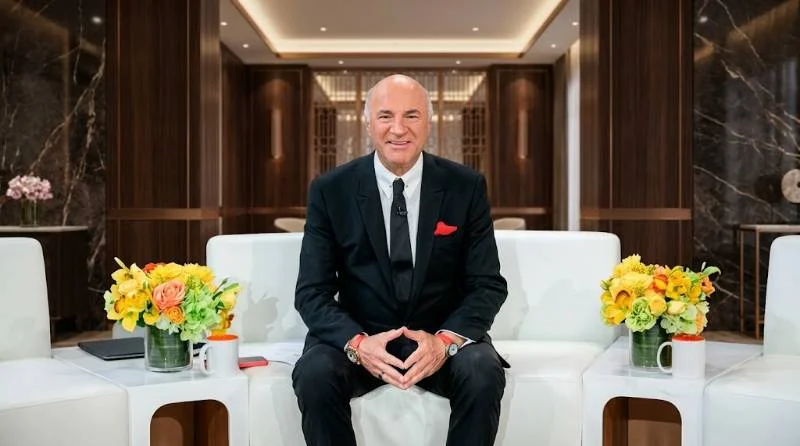
His pay for the show is not publicly confirmed. Several aggregator pages list annual income anywhere from $5 million to $50 million without a verifiable source, and neither Fortune nor Celebrity Net Worth gives a per-episode number. Celebrity Net Worth says the show gave him a steady pipeline of startup deals, which points to deal flow as its main financial value.
The FTX Loss and Crypto Bets
For years O’Leary dismissed bitcoin. In 2019 he called it “useless currency,” according to Wikipedia. By May 2021 he said he held a 3% to 5% allocation and had become a strategic investor in a platform later renamed WonderFi.
In August 2021, FTX announced he would take an ownership stake as part of his pay for serving as a spokesperson. FTX went bankrupt in November 2022, and he was named in a class-action lawsuit alongside other promoters. He has also backed other crypto projects, including Pawthereum.
The sources disagree on the damage. Celebrity Net Worth describes the full $15 million as lost, while Wikipedia’s account of his CNBC interview has him losing $9.7 million in digital assets and about $1 million in equity, with the rest going to fees and taxes.
Data Centers, Film, and Other 2026 Moves
In April 2026, O’Leary announced a joint venture between O’Leary Digital and Utah’s Military Installation Development Authority to build a data center campus in Box Elder County. Wikipedia reports that the Stratos Project would span roughly 40,000 acres, could use up to 9 gigawatts at full capacity, and would run off-grid on natural gas from the Ruby Pipeline. County officials approved the proposal on May 4, 2026.
Scientists and residents have raised concerns about energy and water use. On May 12, O’Leary accused two Utah nonprofit groups opposing the project of being funded by the Chinese government, and Wikipedia notes he offered no evidence. The groups sued him and Fox News Network in July 2026.
No source reviewed gives the project’s cost or his ownership share, so it cannot be counted in any estimate yet. On screen, he made his acting debut as Milton Rockwell in Marty Supreme in 2025.
The 2017 Political Run and Its Debt
O’Leary entered the race to lead Canada’s Conservative Party on January 18, 2017, and was a frontrunner in the polls for most of it. He dropped out on April 26, saying weak support in Quebec would make it hard to beat Justin Trudeau in the next election.
The campaign left a financial mark. In November 2018 he sued Elections Canada over a rule that capped candidates at $25,000 of their own money for a leadership campaign. According to Wikipedia, he still owed creditors $430,000 at the time, and he argued the cap discouraged wealthy candidates and hurt businesses that had pledged money. A debt of that size is small next to either net worth estimate, but it shows that his cash was not unlimited.
How He Says He Builds and Keeps Money
His mother, a small-business owner and investor, taught him to save a third of what he earns. He only learned how well she had invested after her will was read, according to Wikipedia. His own rules follow from that: he has said he will not buy a public stock unless it pays a dividend, keeps 5% of his portfolio in physical gold, and suggests holding bonds equal to your age as a percentage.
Fortune quotes him calling the moment he became a millionaire “very anticlimactic.” He has also said the climb from $1 million to $5 million was easier than reaching the first million, which took the discipline of not buying things he did not need. These are his stated views, not personal financial advice, and his funds drew the criticism described above.
Age, Family, and Homes
O’Leary turned 72 on July 9, 2026. He earned his first degree at the University of Waterloo in 1977. He married Linda Greer in 1990, and the couple separated in 2011 before resuming their marriage two years later. They have two children, Trevor and Savannah.
He holds Canadian, Irish, and Emirati citizenship. Wikipedia says the couple lives in Miami Beach and Toronto, with a cottage in Muskoka, Ontario, and homes in Boston and Geneva. Celebrity Net Worth lists Toronto as his primary home, so the two sources differ on where he is based.
His spending habits show up in public. He collects watches and often wears two at once, and he is a lifelong photographer who has sold prints and given the proceeds to charity, according to Wikipedia. He also has dyslexia, which he has said helped him think differently in business.