

David was the second king of ancient Israel, a shepherd from Bethlehem who killed the giant Goliath, joined the twelve tribes under one throne, and wrote many of the Psalms. If you are asking who is David in the Bible, that is the short answer. The longer one is more interesting, because Scripture tells his story with an honesty it rarely gives any hero.
His life fills much of 1 Samuel, 2 Samuel, 1 Kings, and 1 Chronicles. Readers meet a musician, a soldier, a fugitive, a poet, and a king who commits adultery and arranges a murder. That mix of faith and failure is why people are still reading about him three thousand years later.
David at a Glance
| Category | Details |
|---|---|
| Name | David is a Hebrew name usually translated as “beloved.” |
| Family | The youngest of Jesse’s eight sons, from the tribe of Judah, and a great-grandson of Ruth and Boaz (Ruth 4:17–22; 1 Samuel 16) |
| Role | The second king of Israel, after Saul |
| Reign | About 40 years: seven and a half years in Hebron and thirty-three years in Jerusalem (2 Samuel 5:4–5) |
| Best-Known Acts | Defeating Goliath, capturing Jerusalem, and bringing the Ark of the Covenant into the city |
| Writings | Seventy-three psalms carry his name in their headings |
| Dates | Traditionally placed around 1000 BCE |
A Shepherd Boy From Bethlehem
David began as the overlooked son. When the prophet Samuel came to Jesse’s house to anoint a replacement for King Saul, Jesse paraded seven sons past him, and David was left out in the fields with the sheep (1 Samuel 16). Samuel anointed the youngest, after being told that people judge by appearance while God looks at the heart.
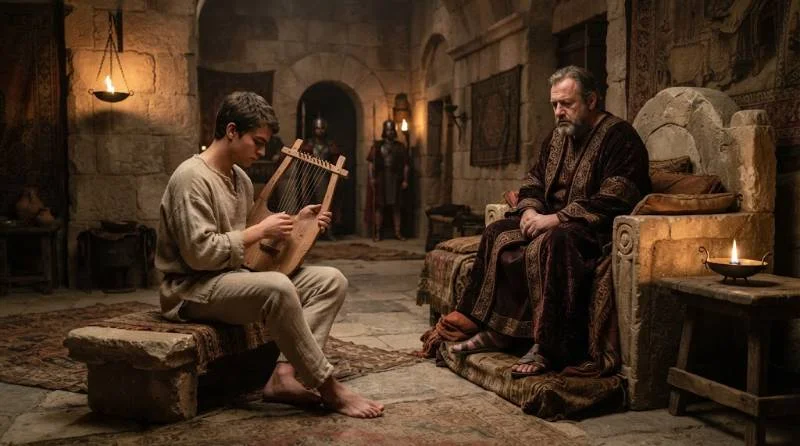
The anointing did not change his daily life at first. David went back to his flock and also began playing the lyre for Saul, whose moods had turned dark (1 Samuel 16:14-23). He entered the palace as a musician, a detail most summaries skip, and Saul liked him enough to make him an armor bearer.
The Day David Faced Goliath
The most famous scene in David’s story comes in 1 Samuel 17. Israel and the Philistines faced each other across the Valley of Elah, and a Philistine champion from Gath named Goliath challenged any Israelite to single combat. For forty days, nobody answered.
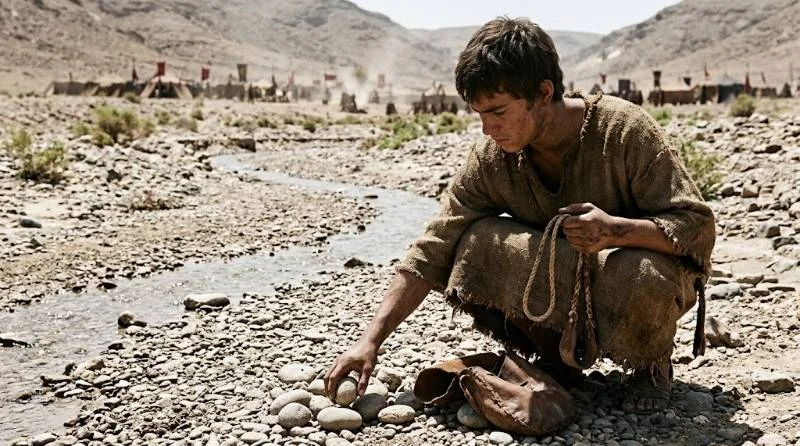
David arrived to bring food to his brothers, heard the challenge, and volunteered. Saul offered his own armor, but David could not move in it. He took a staff, a sling, and five smooth stones from a stream, and one stone to the forehead brought Goliath down.
Goliath’s size is a small puzzle of its own. The traditional Hebrew text gives his height as six cubits and a span, nearly ten feet, while the Dead Sea Scrolls and the Greek Septuagint read four cubits and a span, about six and three-quarter feet. Either way, David told Saul he trusted God, not weapons.
Years on the Run From Saul
Victory made David a national hero, and that is where his trouble started. Women sang that Saul had killed his thousands and David his tens of thousands, and Saul never forgave the comparison (1 Samuel 18:7-9). David married Saul’s daughter Michal and grew close to Saul’s son Jonathan, yet the king still tried more than once to kill him with a spear.
David fled and spent years as an outlaw leader. Hundreds of men in debt or distress gathered around him at the cave of Adullam (1 Samuel 22:1-2). Along the way he married Abigail, whose wealthy husband Nabal had refused to feed David’s men, after she brought food and talked him out of a revenge attack (1 Samuel 25).
Jonathan, who as Saul’s heir had the most to lose, helped David escape and made a covenant of loyalty with him (1 Samuel 20). Years later, David honored it by seating Jonathan’s son Mephibosheth at his own table (2 Samuel 9). David also twice had the chance to kill Saul, once in a cave at En Gedi and once in Saul’s own camp, and both times he walked away (1 Samuel 24 and 26).
Running out of safe places, David took refuge with the Philistine king Achish of Gath and settled in the town of Ziklag (1 Samuel 27). For a man who had killed a Philistine giant, it was an awkward place to live. It shows how little room Saul had left him.
How David Became King
Saul and Jonathan died fighting the Philistines on Mount Gilboa (1 Samuel 31). David mourned both in a lament preserved in 2 Samuel 1. The tribe of Judah then anointed him king at Hebron, while Saul’s surviving son Ish-bosheth ruled the northern tribes (2 Samuel 2).
The two sides fought for years until Ish-bosheth was murdered and the northern elders asked David to rule them too (2 Samuel 5:1-3). He captured Jerusalem from the Jebusites, renamed it the City of David, and made it his capital. The city sat between the southern and northern tribes, which made it a practical choice.
Next, David brought the Ark of the Covenant into Jerusalem with music and dancing (2 Samuel 6). He wanted to build a permanent temple, but the prophet Nathan told him his son would build it and that David’s dynasty would last forever (2 Samuel 7). That promise, called the Davidic Covenant, is the root of everything later said about the Messiah.
David was also a successful commander. The books of Samuel record wars against the Philistines, Moabites, Edomites, Ammonites, and Arameans, and by the end the kingdom reached well beyond the old tribal territories (2 Samuel 8 and 10). The Bible presents this as the peak of Israel’s power, though historians still argue over how large the realm really was.
The Fall: Bathsheba, Uriah, and Nathan
The Bible does not hide David’s worst moment. In 2 Samuel 11, while his army was fighting the Ammonites, David stayed in Jerusalem, saw Bathsheba bathing, and summoned her. She became pregnant, and her husband, Uriah the Hittite, was a soldier at the front.
David first tried to bring Uriah home so the child would look like his. When Uriah refused to enjoy comfort while his comrades camped in open fields, David sent a letter to the commander Joab ordering that Uriah be left exposed in battle. Uriah died, and David married Bathsheba.
Nathan confronted him with a story about a rich man who took a poor man’s only lamb. David saw himself in it and said, “I have sinned against the Lord” (2 Samuel 12:13). Nathan told him he would not die, but the child would, and violence would stay in his household. Psalm 51, which tradition links to this episode, is one of the best-known prayers of repentance.
Absalom’s Revolt and the Final Years
Nathan’s warning played out inside David’s own family. His son Amnon assaulted his half-sister Tamar, and her brother Absalom killed Amnon two years later (2 Samuel 13). David’s slow response to both crimes left Absalom bitter, and in time Absalom raised a rebellion and drove his father out of Jerusalem (2 Samuel 15).
The revolt ended in a forest battle where Joab killed Absalom against David’s wishes. The king’s cry, “O my son Absalom, my son, my son Absalom,” is one of the most human moments in the Hebrew Bible (2 Samuel 18:33).
In old age, another son, Adonijah, tried to claim the throne. Bathsheba and Nathan made sure David named Solomon as his successor, and David died after about forty years as king (1 Kings 1 and 2).
David’s Wives and Children
David had several wives, and the text names Michal, Ahinoam, Abigail, Maacah, Haggith, and Bathsheba, among others (2 Samuel 3:2-5; 1 Chronicles 3). Their sons became rivals, which explains much of the trouble later in his reign.
Amnon was the eldest, Absalom was the third, and Adonijah was the fourth in the list. Solomon, born to Bathsheba, was not the obvious heir, yet he ended up with the throne and built the temple David had wanted to build.
The family story matters because the Bible treats it as consequence, not coincidence. A king who took what he wanted found that his sons learned to do the same.
The Psalms of David
Seventy-three of the 150 psalms in the Hebrew Bible carry the heading “of David.” That includes Psalm 23, “The Lord is my shepherd,” one of the most recognized passages in Scripture. Psalm 51 and Psalm 139 show a writer who confesses, argues, and praises in the same breath. Several headings tie a psalm to a specific event, such as Psalm 3 to his flight from Absalom and Psalm 51 to Nathan’s confrontation.
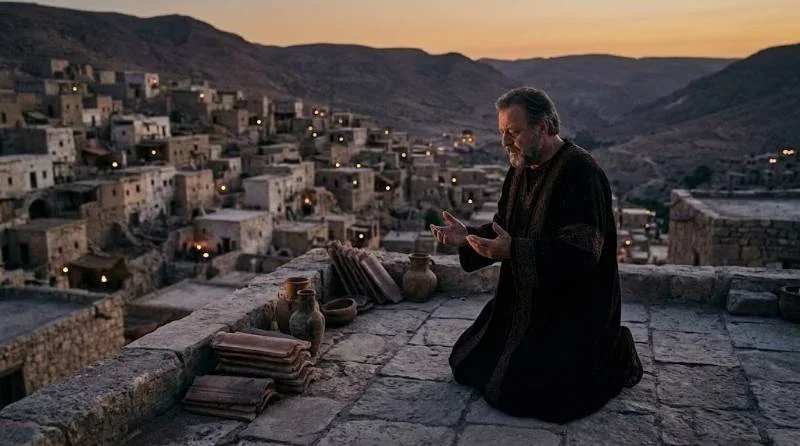
Scholars debate how many of these psalms David wrote himself, since the heading can mean “by David,” “for David,” or “in the style of David.” What is not debated is the effect. David became the model of the praying believer, and his psalms are still read aloud in synagogues and churches.
Is David a Real Historical Figure?
Most of what we know about David comes from the Bible, which raises fair questions. The strongest outside evidence is the Tel Dan inscription, an Aramaic stone fragment found in northern Israel in 1993 and 1994 and dated to the ninth century BCE. The Biblical Archaeology Society calls it the first historical evidence of David outside the Bible, since it refers to a “house of David.”
Scholars disagree on the rest. Some see David as a real tribal leader whose kingdom was smaller than the Bible describes, while others accept more of the biblical account. No confirmed palace or tomb has been found, and the debate over the size of his realm continues.
One more detail is worth knowing. 1 Chronicles retells David’s reign but leaves out the Bathsheba affair and Absalom’s revolt. The writers of Samuel and Chronicles shaped the same king for different audiences.
Why David Matters to Jews, Christians, and Muslims
In Judaism, the Messiah is expected to come from David’s family line. Christians read the opening of Matthew and the third chapter of Luke, which both trace Jesus back to David, and Matthew 1:1 calls Jesus the “son of David.” In Islam, Dawud is a prophet and king, and the Quran says God gave him the Zabur, a book often identified with the Psalms.
His influence reaches past religion. Michelangelo carved his 17-foot marble David in Florence between 1501 and 1504, and “David and Goliath” is now shorthand for any underdog contest.
What Sets David Apart From Other Biblical Figures
Most heroes in ancient literature are polished. David is not. The Bible calls him “a man after God’s own heart” (1 Samuel 13:14) and also records adultery, murder, and a family in ruins.
Many readers take the phrase to mean his willingness to repent when confronted, not a clean record. That may be why his story feels so current. People relate to a leader who fails badly and still gets another chance.